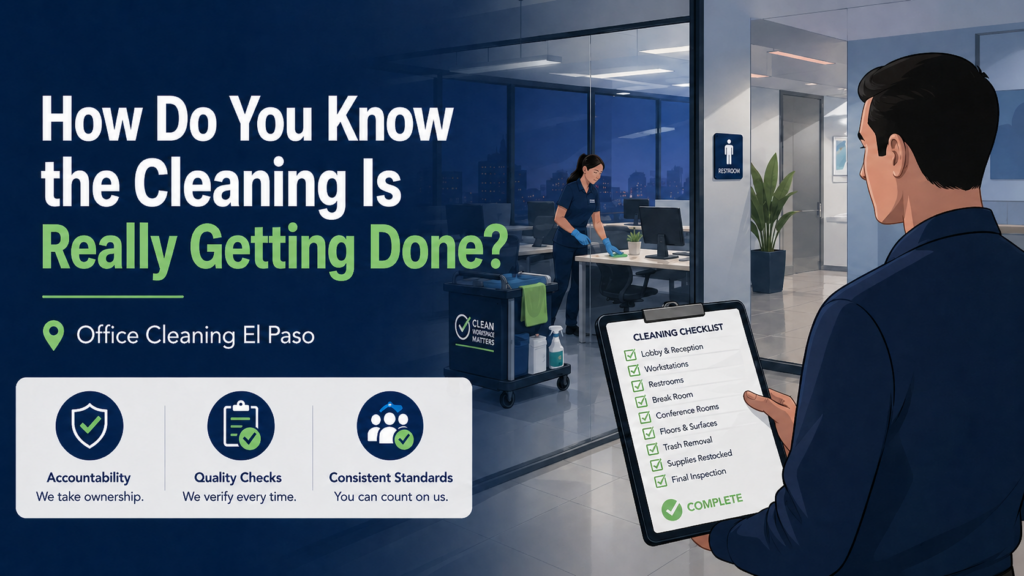
Most office cleaning happens when the business is closed. The cleaner comes in after employees leave, works through the space, and is usually gone before anyone from the office returns the next morning.
That setup makes sense. Cleaning during business hours can interrupt employees, customers, patients, meetings, and daily operations. For many offices, after-hours cleaning is the cleanest arrangement.
But it also creates a real question:
How do you know the cleaning is actually getting done the way it should?
The answer should not be that the office manager has to walk around every morning checking trash cans, restrooms, floors, glass, desks, and supply areas. That turns the client into the quality control system.
A professional cleaning company should not require that.
If a business has to constantly check behind the cleaner, send reminders, report the same issues, and wonder whether the work was actually completed, the problem is not just a missed task. The problem is that the service is not being managed tightly enough.
Reliable office cleaning should give the client confidence without making them supervise the work themselves. That confidence comes from structure: showing up consistently, following the agreed routine, communicating issues, correcting problems, and having oversight in place before small misses turn into regular complaints.
For businesses comparing office cleaning in El Paso, this matters because the real value of a cleaning company is not just whether someone enters the building at night. It is whether the company has a system for making sure the work holds up over time.
You Should Not Have to Watch the Cleaner to Get Consistent Service
A business hires a cleaning company to remove work from its plate, not to create another management responsibility.
That sounds obvious, but many office cleaning problems slowly push the client into a supervisor role. At first, the manager notices one small miss and sends a message. Then it happens again. Then someone has to check the restroom before employees arrive. Then someone starts watching whether the trash was taken out, whether the floors were touched, or whether the same area keeps getting skipped.
Before long, the business is not just receiving cleaning service. It is managing the cleaning service.
That is not how recurring office cleaning should function.
The client should be able to expect the cleaning company to manage its own people, check its own work, and correct its own problems. The office manager may still report issues when they see them, but that should not be the main system keeping the account on track.
When service depends on the client catching problems, quality becomes reactive. Nothing gets addressed until someone complains. Small misses are allowed to repeat. The cleaner may not be coached. The supervisor may not know there is a pattern. The business ends up carrying the burden of noticing, documenting, and following up.
Consistent office cleaning requires the opposite.
The cleaning company should be watching the service from its side. That means there should be a way to know whether cleaners showed up, whether expectations were followed, whether issues were communicated, and whether recurring problems are being corrected.
The client should not need to watch every visit to feel confident. The cleaning company should have enough structure behind the work that the client is not forced to become the inspector.
The Weak Model: “Let Us Know If Something Is Wrong”
One of the weakest ways to manage office cleaning is also one of the most common:
“If there is ever a problem, just let us know.”
At first, that sounds reasonable. Every service business needs a way for clients to report issues. No cleaning company is going to catch every single thing before the client ever sees it.
But when “let us know” becomes the main quality control system, the burden shifts in the wrong direction.
Now the client has to notice the problem, explain it, follow up, and remember whether it has happened before. If the issue comes back, the client has to raise it again.
That turns the office manager into the person tracking quality.
A cleaning company should want client feedback, but feedback should not be the only thing holding the service together. If the company only responds after a complaint, then the account is being managed from the outside in. The client becomes the alarm system.
This is usually where frustration starts to build.
The issue may not be one major failure. It may be small things that keep repeating. A restroom detail gets missed. A side office is skipped. Supplies are not restocked. Certain floor areas slowly decline.
Each issue may seem small by itself. But when the client has to keep pointing them out, the service starts to feel unreliable.
That is the problem with a reactive cleaning setup. It waits for the client to say something before the company pays attention.
For recurring office cleaning, that is not strong enough. The company should still listen when the client reports a concern, but it should also have its own way of finding problems, correcting them, and preventing the same issue from coming back.
A Better Cleaning Company Checks Its Own Work
A stronger office cleaning setup does not wait for the client to catch every problem.
The cleaning company should have its own way of checking whether the service is being done correctly. That does not mean every cleaner is watched every minute or every task is inspected after every visit. It means the company has a structure for staying close enough to the work that problems do not depend entirely on the client noticing them.
That structure matters because cleaning quality can slip quietly.
A cleaner may start strong, then slowly cut corners. A task may get missed because it is not clearly reinforced. A supply issue may affect service for several visits before anyone says anything. A restroom, breakroom, or entry area may begin to decline before it becomes obvious enough for the client to complain.
When the cleaning company checks its own work, those problems are easier to catch early. This is also why businesses should understand how to evaluate the quality of an office cleaning service beyond what the office looks like at a quick glance.
What Internal Checks Can Include
That can happen through supervisor visits, periodic inspections, cleaner communication, account notes, photo documentation, issue tracking, or follow-up after corrections. The exact system may vary by company, but the principle is the same:
The company should be managing the service from its side.
That is what separates a cleaner-dependent service from a managed office cleaning service. In a cleaner-dependent setup, the account mostly depends on whether the assigned cleaner personally remembers, notices, and follows through. In a managed setup, the company has oversight around the cleaner so the account is not resting on one person alone.
For the client, this creates a different experience.
Instead of wondering whether anyone is paying attention, the business knows the cleaning company has a process for checking the work, catching patterns, and correcting issues. The office manager may still communicate when something comes up, but they are not the only person watching the account.
What Better Cleaning Visibility Should Prevent
Better cleaning visibility is not about giving the client more things to review.
It is about preventing the same problems from reaching the client over and over again.
That is the real test. If the office manager has to report the same restroom issue, the same missed trash can, the same unlocked supply problem, or the same neglected area multiple times, then the cleaning company is not controlling the account well enough.
A mistake can happen once. But repeated issues usually mean there is no strong follow-up system behind the service.
The cleaner may not be getting corrected clearly. The supervisor may not be checking the right area. The issue may not be documented. Or the company may be treating every complaint as a separate event instead of recognizing a pattern.
That is where cleaning service starts to break down.
The client may still receive a response when they complain, but the underlying problem keeps coming back. Over time, that creates doubt. The business stops trusting the service. Managers start checking behind the cleaner. Small issues take up more attention than they should.
A better cleaning company uses its own visibility to stop that cycle.
It should know when something was missed, whether the cleaner was coached, whether the correction held, and whether the same issue is starting to repeat. The client does not need to see every internal step, but the results should be visible in fewer repeat problems and a more stable service.
The Real Value Is Not Just a Cleaner Office
A clean office is the expected result.
The larger value is that the business does not have to keep thinking about the cleaning.
That is what consistent office cleaning should provide. Not perfection. Not a promise that nothing will ever be missed. But a service that is managed well enough that cleaning does not become another recurring problem on the manager’s desk.
For offices in El Paso, this matters because many businesses do not switch cleaning companies after one small issue. They switch when the issues keep coming back and no one seems to own the pattern.
That is usually the difference between a company that sends a cleaner and a company that manages the account. The same principle applies across broader commercial cleaning services in El Paso, where the quality of the service depends on how well the account is managed after the sale.
If the service depends entirely on the assigned cleaner doing everything right every night, the account is fragile. If the company has supervision, communication, documentation, and correction built around the cleaner, the account is more stable.
That stability is what clients are really paying for.
They are not just paying for trash removal, restroom cleaning, floors, and dusting. They are paying for the cleaning to stop becoming something they have to chase.
Conclusion
So how do you know the cleaning is really getting done?
You should not have to become the inspector to find out.
The better answer is that the cleaning company should have enough structure around the work to manage the account before repeated issues land on your desk. That means attendance is tracked, problems are communicated, corrections are followed up on, and patterns are not ignored.
Without that structure, the client becomes the quality control system.
With it in place, the service feels different. There are fewer repeat complaints, less chasing, less guessing, and more confidence that the office is being handled without the business having to manage every detail.
That is what reliable recurring office cleaning should do. It should not just make the office look better. It should make the service easier to trust.