
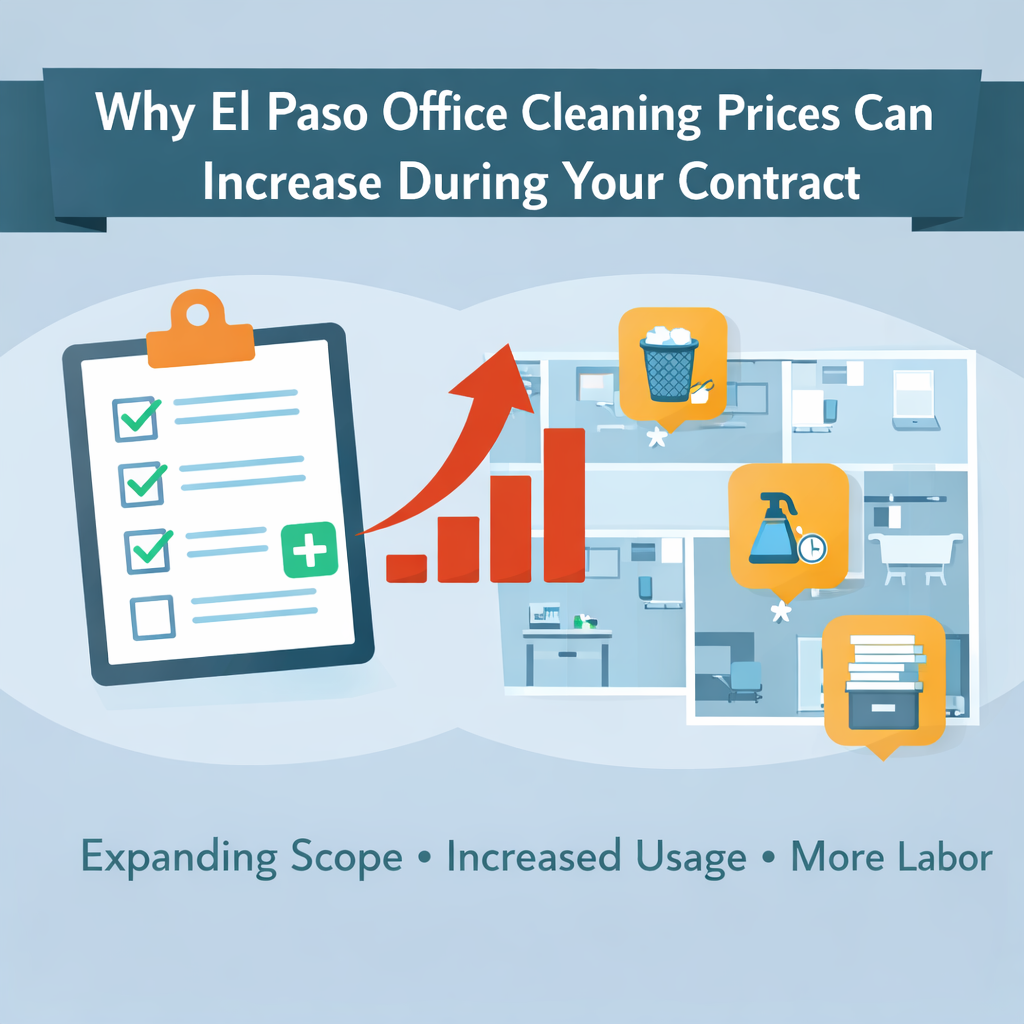
Why Pricing Doesn’t Always Stay Fixed
Most businesses assume their office cleaning El Paso price is locked in once the contract is signed. It gets treated like a fixed monthly cost, something predictable that shouldn’t change unless you ask for something different.
That’s not always how it works.
Cleaning isn’t static. The way your space is used changes. The level of traffic changes. What your team expects from the service can shift over time. Even small changes in those areas can add up to more work being done consistently.
The issue is that those changes don’t always get addressed right away. They build in the background. Then at some point, the gap between what was originally priced and what’s actually being done becomes too big to ignore.
That’s when pricing conversations start happening, and it feels like it came out of nowhere.
To understand why that happens, you have to look at what actually changes after the contract is in place.
Scope Changes That Add More Work
Most mid-contract price increases come down to one thing: more work is being done than what was originally agreed to.
At the beginning, the price is based on a defined scope—what areas are cleaned, how often, and what tasks are included. That’s the baseline.
But that baseline rarely holds.
A space that wasn’t being used before becomes active. A storage area starts getting attention. Someone asks for something small to be handled, and it just gets added in. None of it feels significant on its own, so it doesn’t trigger a conversation.
It just becomes part of the routine.
Over time, those small additions stack. What was originally priced no longer reflects the actual workload, even though nothing was ever formally changed.
That gap is what eventually leads to a pricing adjustment.
Additional Areas or Tasks Get Added
One of the most direct ways costs increase is when the amount of space or work expands.
An office that wasn’t being used before is now active. A conference room goes from occasional use to daily use. Breakrooms and restrooms see more traffic. In some cases, areas that weren’t part of the original scope quietly get picked up by the cleaning team.
No one usually calls it out. It just starts happening.
From the outside, it still feels like the same service. Same building, same schedule, same crew. But the workload isn’t the same anymore.
Every added area or task increases time and labor. Once it becomes part of the routine, it’s no longer extra—it’s expected.
At that point, the original pricing no longer matches the actual work being done.
Small Requests That Turn Into Ongoing Work
A lot of cost creep doesn’t come from big changes. It usually comes from small requests that quietly become part of the routine.
It starts simple. Someone asks for an extra surface to be wiped down, another trash area to be handled, or a problem spot to get more attention. None of it feels significant, so it just gets done without much thought.
The shift happens when those requests stop being occasional and start happening every visit. What was once extra becomes expected.
At that point, it’s no longer a small add-on. It’s part of the job, and it takes time every time the team is there. One or two of these won’t move much, but when they stack up across a space, the workload starts to change.
Once that happens, the original pricing no longer reflects what’s actually being done.
Scope Was Never Clearly Defined From the Start
Sometimes pricing increases aren’t caused by changes. They come from a scope that was never clearly defined in the first place.
During the walkthrough, there’s usually a general understanding of what needs to be cleaned. But if certain areas, details, or expectations aren’t clearly spelled out, both sides can walk away with a different interpretation of what’s included.
At first, it doesn’t create issues. The team handles what they believe is expected, and the client assumes certain things are covered.
Over time, those assumptions turn into consistent work.
That’s where the gap shows up. The service being delivered is bigger than what was originally priced, even though nothing was formally changed.
Eventually, that mismatch has to be addressed, and that’s when pricing comes up.
Frequency and Usage Changes
Even if the scope doesn’t change on paper, how the space is used can change the amount of work required.
An office with light traffic is easier to maintain than one that’s fully active throughout the day. More people means more trash, more restroom use, more wear on floors, and more areas needing attention every time the team comes in.
Nothing was added to the scope, but the effort to maintain the same result is higher.
In other cases, the schedule itself changes. Moving from fewer service days to more frequent cleaning, or adding daytime coverage, directly increases labor and time.
Either way, the workload grows. And when the workload grows, pricing usually follows
Increased Foot Traffic or Business Activity
One of the biggest drivers of added workload is how much the space is actually being used. An office that was only partially occupied can become fully staffed over time, or a business may start seeing more clients throughout the day. Breakrooms, restrooms, and shared spaces get used more often and by more people, and even extended hours can increase how much buildup happens between cleanings.
On paper, nothing has changed. The same areas are still part of the scope. But the condition of those areas is different every time the cleaning team arrives. There’s more trash, more restroom use, more wear on floors, and more overall buildup to deal with.
It takes more time and more effort to bring the space back to the same standard, even though the structure of the service hasn’t changed. Over time, that added workload builds to the point where the original pricing no longer matches what’s required to maintain the space.
Schedule Changes That Affect Labor
Another common driver of pricing changes is when the cleaning schedule shifts. A business might start with fewer service days and later move to more frequent cleaning, or add daytime coverage to handle activity during business hours instead of relying only on after-hours service. Even changes to timing can affect how the work needs to be done.
Each of these changes increases labor. More service days mean more total visits, and adding daytime cleaning can require different staffing or longer coverage windows. What was originally a contained schedule turns into something that requires more time across the week.
From the outside, it can feel like a simple adjustment. But it directly increases the amount of work being done, and when labor increases, pricing follows.
Labor Cost Changes Over Time
Even if nothing changes with your space or schedule, labor costs can still shift over time, and that directly impacts pricing.
Commercial cleaning services are labor-driven. Most of the cost comes from the people doing the work, so when wages increase, hiring gets more competitive, or retention becomes harder, the cost to maintain the same level of service goes up.
This doesn’t always show up right away. It builds gradually as market conditions change and companies adjust to keep positions filled and service consistent.
From your side, it can feel like nothing has changed. The same work is being done on the same schedule in the same space. But behind the scenes, the cost to deliver that service is higher than when the contract started.
At some point, that gap has to be addressed, and that’s when pricing adjustments happen.
Wage Increases and Hiring Pressure
One of the main drivers behind rising labor costs is the pressure to hire and keep reliable workers. When wages increase across the market, cleaning companies have to adjust to stay competitive, otherwise positions go unfilled or turnover starts to affect service.
Even if your service hasn’t changed, the cost to staff that service can increase. It takes more to attract people and more to keep them, especially when competition for labor is tight. This builds over time as wages adjust and hiring becomes more difficult, increasing the cost of maintaining consistent service across accounts.
At that point, pricing adjustments aren’t about added work. They’re about the cost of sustaining the same level of service.
Retention Issues That Affect Staffing Stability
Another factor that drives labor costs is retention. Hiring is one part of the equation, but keeping the same people on an account is what creates consistency.
When turnover increases, stability drops. New people have to be hired, trained, and brought up to speed, which takes time and supervision. It also creates inefficiencies, especially in the short term.
Even if the scope and schedule haven’t changed, the effort required to maintain the same level of service goes up. More time is spent on training, correcting mistakes, and getting the account back to a steady state.
Over time, that added effort becomes part of the cost of delivering the service. And when that cost increases, pricing adjustments follow.
Service Issues That Require More Oversight
In some cases, pricing increases aren’t driven by more space or more usage. They’re driven by how much effort it takes to keep the service consistent.
When an account runs smoothly, it takes a certain level of labor to maintain it. But when issues start showing up—missed tasks, inconsistent quality, recurring complaints—it usually requires more involvement to keep things on track.
That can mean more time spent correcting work, more frequent follow-ups, or additional oversight to make sure standards are being met. None of that changes the scope on paper, but it does increase the amount of effort behind the scenes.
Over time, maintaining the same result starts requiring more work than it originally did.
And when that happens consistently, it can lead to pricing adjustments to account for that added effort.
Rework and Re-Cleaning Becoming Routine
One of the clearest signs that costs are increasing behind the scenes is when rework becomes part of the routine.
Instead of the space being cleaned once and holding up until the next visit, areas start needing to be revisited. Missed tasks get corrected, and problem spots require extra attention, which means the team ends up doing the same work more than once just to reach the expected result.
At first, it shows up as occasional fixes. But when it becomes consistent, it changes how much time is being spent on the account. Now the effort isn’t just maintaining the space—it includes correcting it every visit.
That added time isn’t always visible, but it increases the total workload. And once that becomes part of the normal process, it pushes the cost of delivering the service higher.
Increased Supervision or Inspection Frequency
Another way costs increase is when more oversight is needed to keep the service consistent.
When an account is stable, it runs with a normal level of supervision. But when issues start showing up—whether it’s inconsistent quality, complaints, or missed expectations—it leads to more frequent check-ins, inspections, and follow-up.
That added oversight takes time. Supervisors spend more time on-site reviewing work, addressing issues, and making sure standards are being met.
None of that changes the scope on paper, but it increases the effort required to maintain the account. And when that level of involvement becomes ongoing, it pushes the cost of delivering the service higher.
One-Sided Pricing vs Structured Pricing
Not all pricing is built the same, and that affects how increases show up.
Some agreements are set as a flat number with no clear structure behind how changes are handled. Everything feels fixed until the workload shifts, and then pricing gets revisited all at once, which is when it feels abrupt.
Other agreements are built with structure from the start. The scope is clearly defined, and there’s an understanding of how changes in space, frequency, or workload affect pricing. Adjustments are tied to what’s actually happening, not treated as exceptions.
Pricing doesn’t stay fixed forever in either case. The difference is whether changes feel sudden or expected.
Without structure, increases feel unpredictable. With structure, they follow the workload and are easier to understand when they happen.
How Pricing Increases Actually Show Up
Most pricing increases don’t happen randomly. They usually show up after a period where the workload and the original pricing have already drifted apart.
In some cases, it comes through as a formal adjustment during a contract review. The scope is revisited, the workload is discussed, and pricing is updated to reflect what’s actually being done.
In other cases, it shows up more abruptly. A business might be told that pricing needs to change without much context, which is where confusion tends to come in.
The difference usually comes down to how closely the service has been managed over time. When scope and workload are regularly reviewed, adjustments feel more predictable. When they’re not, the gap builds quietly until it has to be addressed all at once.
Either way, the increase is typically tied to work that has already been happening, it just hasn’t been accounted for yet.
Why Pricing Increases Feel Unexpected
Pricing increases usually don’t come from a single change. They build over time.
Small additions to the scope, increased usage, shifts in labor, and extra effort to keep the service consistent all stack in the background. By the time it’s addressed, the gap between what was originally priced and what’s actually being done is already there.
That’s why it feels unexpected.
From your side, it can seem like nothing changed. But the workload and the cost to maintain that service have already moved.
Once that gap is clear, pricing follows.
And if that gap isn’t being tracked along the way, it will always show up later as a pricing conversation.