Why This Matters
When a business hires a company for office cleaning in El Paso, the first concern is usually the result. Will the office stay clean, will the service stay consistent, and will problems actually get fixed when something goes wrong. That is what most people focus on. What gets less attention is how much the company’s internal structure affects all of that once service begins.
That matters even more because most office cleaning in El Paso happens after hours, when the office is empty and no one from your side is there to watch what is happening. At that point, you are relying almost entirely on the company to control who enters your building, how they work, and how issues get handled. That is where the company’s labor model stops being an internal detail and starts becoming your problem too.
Cleaning Happens Without You There
Most office cleaning is done after the workday ends. Your team goes home, the office is quiet, and the cleaning crew comes in when no one is around. That is normal, but it also means you usually do not see who showed up, how they handled the space, or whether the work was done with any real consistency.
That lack of visibility changes the equation. You are not just paying for tasks to get done. You are trusting the company to manage access, behavior, and performance when your office is empty. When the service happens out of sight, the company’s level of control over the people doing the work matters a lot more.
You’re Trusting the Structure Behind the Service
When you hire a cleaning company, you are not just hiring a crew to clean your office. You are trusting the system behind that crew. You are trusting how people are brought in, how standards are enforced, and how much control the company actually has over the people entering your building.
From the outside, two companies can look almost the same. Both may sound professional, both may make similar promises, and both may come across well during the walkthrough. But if one is using its own employees and the other is handing the work off to subcontractors, the level of control behind the service can be very different. That difference can show up in consistency, accountability, and how problems get handled once the job is underway.
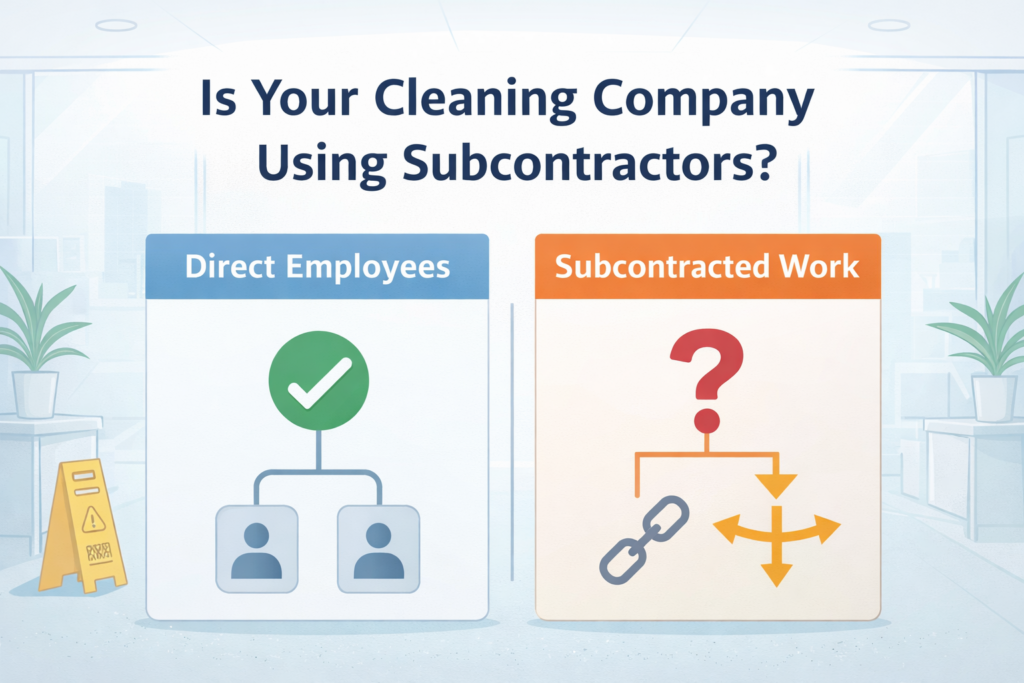
Employees vs Subcontractors: The Difference
A lot of businesses never think to ask how the cleaning company is actually staffed. From the outside, it may not seem like an important distinction. The company has a name, a quote, a schedule, and someone assigned to clean the office. On the surface, that feels like enough.
But the service model behind the company affects how much control they really have once the work starts. If the people cleaning your building are employees of the company, that usually means the company has direct responsibility for hiring, training, scheduling, and oversight. If the work is being subcontracted, that control can look very different.
How Employee-Based Companies Operate
With an employee-based model, the people doing the work are part of the company itself. They are hired directly, trained under that company’s standards, and expected to follow its procedures and reporting structure. If there is a problem, the company is dealing with its own team, not a separate party working under a loose arrangement.
That usually gives the company more direct control over day-to-day service. They can reinforce expectations, correct issues faster, and keep service aligned from one visit to the next. It does not automatically mean the service will be good, but it does mean the company has a clearer line of responsibility over the people entering your office.
How Subcontractor-Based Companies Operate
With a subcontractor model, the company selling the service may not be the same group directly performing the work. Instead, they may assign accounts out to outside cleaners or separate operators who handle the actual cleaning. That can create more distance between the company you hired and the people showing up at your building.
That distance matters because responsibility can start to blur. The company may still manage the account on paper, but it may not have the same level of direct control over training, consistency, communication, or how closely standards are followed. For a client, that difference may not be obvious at the beginning, but it can become much more noticeable once service is underway.
Where Risk Starts to Show
The difference between employees and subcontractors usually does not show up in the quote or during the walkthrough. Early on, the service may look fine. The office gets cleaned, the schedule is followed, and nothing feels obviously off. The real difference tends to show up later, once the account settles into normal day-to-day service.
That is when a business starts to see how tightly the company is actually managing the work. If the structure is solid, small problems get corrected before they turn into patterns. If the structure is loose, those same problems tend to hang around longer and show up in more noticeable ways.
Control Over Who Shows Up
One of the first signs is whether the company seems to have a firm handle on who is entering your building. When a company directly manages its workforce, there is usually a clearer chain behind the service. They know who is assigned, they know when changes are made, and they are in a better position to control access to the account.
When the work is subcontracted, that can get less clear. People may rotate in and out more easily, and the company you hired may not have the same day-to-day grip on who is actually showing up. For a client, that can create a quieter kind of risk because the lack of control is not always visible until something feels off.
Consistency of Work
This is where a lot of businesses start to feel the difference. When the people doing the work are operating under one company’s direct expectations, the service usually holds together better over time. There is a steadier standard behind the work, even if every visit is not exactly the same.
With subcontracted service, that steady rhythm can be harder to maintain. The work may still get done, but the level of detail, care, or follow-through can shift more from visit to visit. Instead of one stable standard, the client may start experiencing a more uneven pattern.
Accountability When Issues Happen
Every cleaning account runs into issues at some point. Something gets missed, something is not handled well, or something needs to be revisited. What matters is how quickly the company can take hold of the problem and get it fully corrected.
That tends to be more straightforward when the company is dealing with its own team. With subcontracted work, there can be more distance between the company managing the account and the people doing the cleaning. That extra layer can slow things down, blur responsibility, and make it harder for the client to feel like the issue is truly being owned from start to finish.
What This Looks Like in Real Service
Most businesses don’t catch this upfront. The service starts, things look fine, and nothing stands out right away. The difference shows up later, once the account settles in and you start seeing how the service actually holds up over time.
It doesn’t show up as one big issue. It shows up in patterns. The work gets done, but it feels uneven. Small things get missed, then handled, then missed again. Over time, it starts to feel like the service is not being held to a steady standard.
Different Results Visit to Visit
One visit looks solid. The next one feels rushed. Then it improves again. That back-and-forth is usually where frustration starts, because there’s no clear baseline for what you’re going to get.
When the people doing the work are not tightly managed under one structure, that kind of variation is more likely to happen. From your side, it can feel like the service depends too much on who showed up that night rather than a consistent expectation being followed every time.
Problems That Don’t Fully Get Resolved
You bring up an issue, it gets addressed, and for a short time it looks fixed. Then it comes back, which is something many businesses deal with when they’re not happy with their office cleaning in El Paso.
That usually points to weak follow-through behind the scenes. The issue gets passed along, but not fully owned. Without direct control over the people doing the work, it becomes harder to lock in a correction and keep it from repeating. From your side, it starts to feel like you’re having the same conversation more than once without getting a lasting result.
How to Tell What You’re Getting
A lot of businesses do not find out how a cleaning company is structured until after service starts, even when comparing options for commercial cleaning in El Paso. That is why it helps to ask a few direct questions before making a decision, especially if you are comparing office cleaning in El Paso and trying to understand what sits behind the quote.
You do not need to turn it into an interrogation. The goal is simply to understand whether the company directly manages the people cleaning your building or whether the work is being handed off. That difference may not be obvious from the proposal, but it can tell you a lot about how the account is likely to run once service begins.
Questions to Ask During a Walkthrough
A simple place to start is asking who will actually be cleaning your office and whether those people work directly for the company. You can also ask how staffing changes are handled, who supervises the account, and what happens if there is a recurring issue. Those questions are easy to ask, but they can reveal a lot about how much control the company really has over the service.
You can also listen for how clearly they explain their process. A company with direct control usually has a more straightforward answer because the chain is simpler. They know who is assigned, who oversees the work, and how problems get addressed. If the answers stay vague or keep shifting toward general promises, that can be a sign that the structure behind the service is looser than it first appears.
What to Pay Attention to in Their Answers
The words matter, but the clarity matters too. If a company answers in a direct way and can explain how the account is managed, that usually shows a stronger grip on the service. If the response feels slippery, overly polished, or unclear about who is actually doing the work, that is worth paying attention to.
A business does not need every internal detail, but it should be able to understand who is responsible for the people entering the building each night. That is a basic trust question. When the answer is hard to pin down, it becomes harder to feel confident about how the service will hold up once the contract is signed.
Why It Matters for Office Cleaning in El Paso
This is not just a technical difference in how companies operate. It connects directly to how reliable the service feels once it becomes part of your routine. When you are evaluating office cleaning in El Paso, you are not only choosing a price or a schedule. You are choosing how much control the company has over what happens inside your building when no one is there.
That becomes more noticeable over time. A structure with tighter control tends to hold together better. A looser structure may still work at first, but it is more likely to drift as time goes on. That difference shows up in how steady the service feels week after week.
After-Hours Access
Most cleaning happens when your office is empty. Lights are off, doors are locked, and the people entering your space are doing so without anyone from your team present. That makes access and trust a real concern, not just a formality.
When a company has direct control over its workforce, there is usually a clearer line behind who has access and how that access is managed. When the structure is less direct, it can be harder to feel confident about who is coming in and how tightly that process is being handled.
Long-Term Reliability
The bigger impact shows up over time. Office cleaning is not a one-time service. It is something that happens over and over again, which means small differences in how the service is managed start to add up.
When the company has a stronger hold on its operation, the service tends to stay more stable. When that control is weaker, the service can feel more unpredictable. From a client’s point of view, that often shows up as inconsistency, repeated issues, and a feeling that the account is not being managed as closely as it should be.
Closing
From the outside, most cleaning companies look similar. They offer a schedule, a price, and a list of tasks. What is harder to see is how the work is actually being carried out once the account starts.
The difference between employees and subcontractors is not just an internal choice. It shapes how much control the company has, how consistent the service feels, and how problems get handled over time. That is why it is worth understanding before making a decision.
If you are comparing providers for office cleaning El Paso, the question is not only what they promise, but how they run the service behind the scenes. That structure is what determines whether the service stays steady or starts to drift once it becomes part of your day-to-day operations.