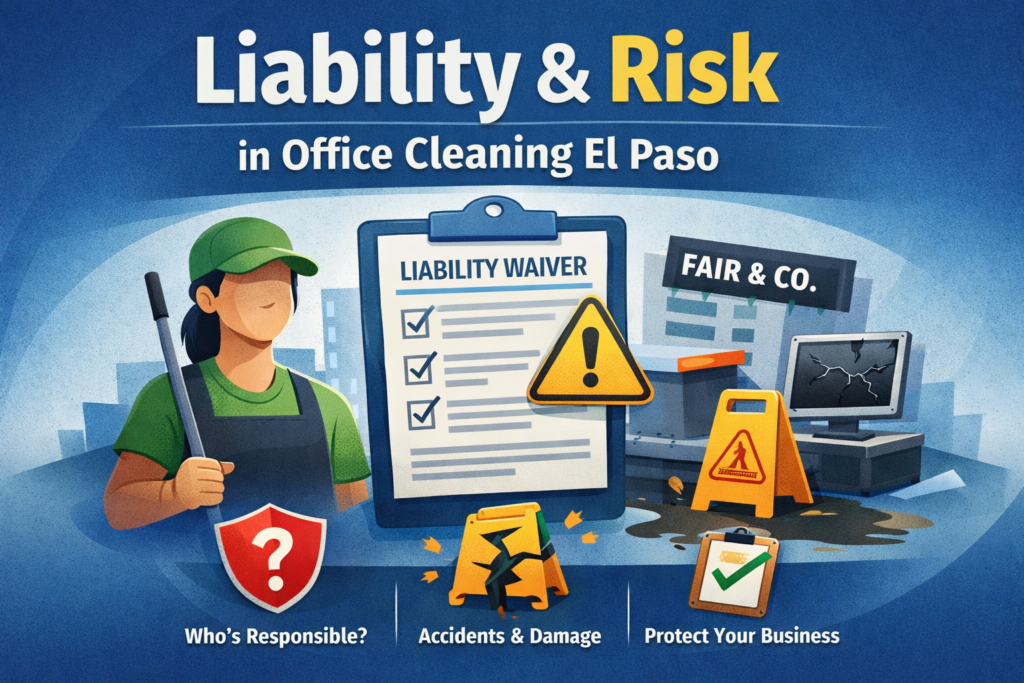
Why Liability Matters in Office Cleaning
When most businesses think about office cleaning, they focus on how the place looks. Is it clean? Does it feel maintained? Are things getting done consistently?
What usually doesn’t come up is liability.
Cleaning happens inside your space, around your equipment, your floors, your restrooms, and your entryways. It involves movement, water, chemicals, and access to your building. Every visit introduces some level of risk, whether anyone is thinking about it or not.
Most of the time, nothing goes wrong. But when something does, it’s not small. A scratched floor, damaged furniture, a broken fixture, or a wet floor that leads to a slip can quickly turn into a real issue.
At that point, the question becomes simple. Who is responsible?
A lot of businesses assume the cleaning company will take care of it. Sometimes they do. Sometimes they can’t. It depends on how they’re set up, what coverage they actually have, and who is doing the work.
That’s where problems start.
Office cleaning in El Paso is a routine service, but the risk behind it is rarely talked about clearly. Understanding where that risk comes from, and how it’s handled, is what keeps a small issue from turning into a bigger one.
The Most Common Risks Businesses Overlook
Most problems don’t come from major incidents. They come from normal situations that aren’t handled carefully or consistently. These are the issues that stay under the radar until they turn into something bigger.
Property Damage During Routine Cleaning
Property damage is one of the most common risks, and it usually isn’t caused by one big mistake. It’s repeated, small actions.
A vacuum hitting the same section of a wall. The wrong chemical used on a surface. Floors losing their finish because they’re being cleaned the wrong way. Furniture getting moved without care.
Each instance feels minor. The result is not. By the time it’s noticed, the damage is already there and often not easy to fix.
Access and Security Issues
Cleaning usually happens after hours, which means someone has access to your building when no one else is around.
Keys, alarm codes, and entry points have to be handled correctly every time. If something gets left unlocked or access is handled loosely, it creates a problem that has nothing to do with how well the place was cleaned.
Most businesses don’t think about this until something feels off. The exposure has been there the entire time.
On-Site Injuries and Accidents
Injuries are part of the risk.
Wet floors, equipment left out, or a missing caution sign can lead to someone slipping or getting hurt. It doesn’t take much.
Once that happens, it moves beyond cleaning. It becomes a liability tied to your property and the conditions inside your space.
These situations are not rare. They’re what happens when there isn’t enough control behind the work.
Who Is Responsible When Something Goes Wrong
When something goes wrong, most businesses assume the cleaning company will take care of it.
Sometimes that’s true. Sometimes it’s not.
Responsibility depends on how the company is structured and who is actually doing the work. That’s where things start to get unclear.
Employee vs Subcontractor Responsibility
If the cleaners are employees of the company, responsibility is usually straightforward. The company hires them, trains them, and manages their work. If something gets damaged or an issue comes up, it falls back on the company.
It changes when subcontractors are involved.
With subcontracting, the person cleaning your building may not work for the company you hired. They’re a separate party. That can shift how responsibility is handled. In some cases, the company may push the issue onto the subcontractor. This is a common setup discussed in should you hire a company that subcontracts office cleaning in El Paso.
From your side, nothing changed. You hired one company. But behind the scenes, it can turn into multiple parties trying to figure out who is responsible.
That’s where things slow down.
Where Insurance Actually Applies
Insurance is where most people expect things to be covered, but coverage isn’t automatic.
A company may say they’re insured, but it depends on what the policy includes and who it applies to. If the person doing the work isn’t properly covered, or the situation falls outside the policy, there can be gaps.
That’s when a simple issue turns into a process. Instead of a clear resolution, it becomes a back-and-forth over what’s covered, who is responsible, and how it gets handled.
What “Being Insured” Actually Means
When a cleaning company says they’re insured, most businesses take that at face value. It sounds like everything is covered.
That’s not always the case.
Insurance only matters if it’s set up correctly and actually holds up when something happens.
General Liability Coverage
General liability is what typically covers property damage.
If something is broken, scratched, or damaged during cleaning, this is the coverage that’s expected to handle it. But it only works if the situation falls within the policy and is reported the right way.
Not every type of damage is treated the same, and not every claim gets approved.
Workers’ Compensation Coverage
Workers’ compensation covers injuries to the people doing the work.
This matters more than most businesses realize. If someone gets hurt while cleaning your facility and they’re not properly covered, it creates a different situation. Responsibility becomes unclear, and it can start to involve your side.
When proper coverage is in place, those situations stay contained within the company. When it’s not, they don’t.
Where Coverage Falls Short
The issue isn’t whether a company has insurance. It’s whether that coverage holds up in real situations.
If policies are limited, outdated, or don’t fully apply to the people doing the work, gaps show up. And those gaps only become visible when something goes wrong.
That’s when expectations and reality separate. What sounded covered at the beginning turns into something that has to be worked through after the fact.
How Issues Are Handled in Practice
What matters isn’t just that something went wrong. It’s what happens next.
In some cases, the situation is acknowledged right away. It’s documented, communicated clearly, and resolved without much back-and-forth. You know what happened and what’s being done about it.
In other cases, it drags out.
The problem gets mentioned but not clearly documented. Communication goes back and forth without a clear answer. Responsibility isn’t owned right away. Instead of a resolution, it turns into waiting and following up.
That difference comes down to how the company operates.
When there’s structure behind the service, there’s a clear way of handling problems. What happened gets recorded. The right people are involved. Action is taken without delay. You’re not left guessing.
When that structure isn’t there, everything depends on the moment. One situation might get handled quickly, while another gets ignored or delayed. There’s no consistency.
From the outside, both companies can look the same. The difference shows up when something goes wrong.
That’s when you find out if there’s a clear process in place, or if it’s being figured out as it happens.
How to Reduce Risk Before It Starts
Most of the risk tied to cleaning can be controlled before anything happens. It comes down to how the service is set up from the beginning.
Verifying Coverage and Setup
Start with what’s actually in place.
Not just whether the company says they’re insured, but what that coverage includes and who it applies to. Are the people doing the work covered, or is there a gap between the company and the individuals on-site?
You also need to understand how the company operates. Are they using employees or subcontractors? Who is responsible for the work day to day? How is that work being managed?
These details determine what happens later. If they’re unclear at the start, they don’t get clearer when something goes wrong.
Why Oversight Matters
Risk comes down to control over the work.
If the service depends on one person showing up and doing the work, there’s nothing catching mistakes or preventing problems. Everything relies on that individual.
When there’s oversight, someone is checking the work, reinforcing expectations, and stepping in when something isn’t right.
That’s what keeps small issues from building into bigger ones. Problems still happen, but they don’t get ignored or repeated.
Final Take on Risk and Office Cleaning in El Paso
Risk is part of any service that happens inside your building. Cleaning is no exception.
What matters is how controlled that risk is from the start.
Most businesses don’t think about liability until there’s already a problem. At that point, it turns into figuring out responsibility, dealing with delays, and trying to get a clear answer.
A better approach is to understand how the company operates before you ever get there, especially when reviewing different commercial cleaning services in El Paso.
That’s what determines how situations play out.
Office cleaning in El Paso isn’t just about keeping a space clean. It’s about having a setup where problems are handled directly and don’t turn into something bigger.