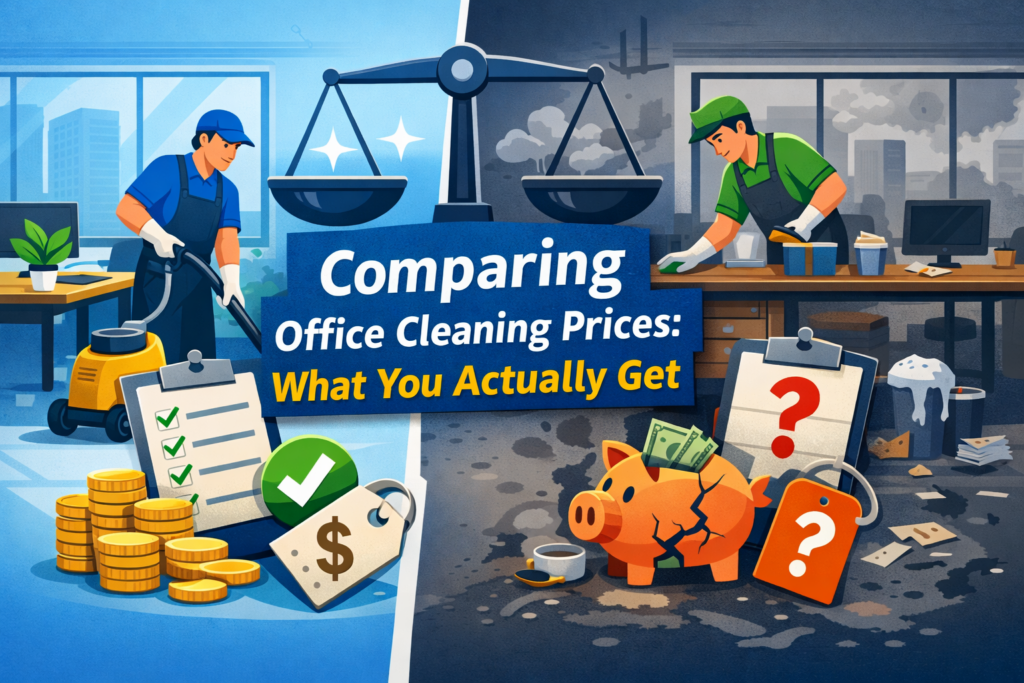
If you’re comparing office cleaning prices in El Paso, you’ve probably noticed something: the numbers often look similar.
Similar monthly totals. Similar service frequency. Same square footage.
That does not mean you’re comparing equal services.
Commercial cleaning proposals can be built on very different operational structures while producing similar pricing. The differences rarely show up in the headline number. They show up in labor allocation, supervision depth, scope detail, supply inclusion, and quality control systems.
Those structural variables determine whether service remains stable over time or slowly degrades.
This article breaks down what actually separates comparable-looking bids — so you can evaluate proposals based on operational substance, not just cost.
Why Similar Pricing Can Produce Different Outcomes
A monthly price is just a number. It does not show how the service is built behind the scenes.
Two cleaning companies can land within the same price range while making very different decisions about how the work will actually be done.
The first difference is how much time is assigned to your building. One proposal may allow enough cleaning time to complete the work thoroughly. Another may assume the job can be done faster. On paper, both say “3 times per week.” In reality, one crew may be in your building significantly longer than the other. Over time, that difference shows up as rushed restrooms, missed corners, and tasks that slowly stop getting done.
The second difference is how the scope is interpreted. Most proposals list similar tasks: vacuuming, mopping, restroom cleaning, trash removal. What varies is how thoroughly those tasks are handled and how often deeper items are addressed. Are baseboards wiped regularly? Are high-touch surfaces detailed daily? Is high dusting included or extra? A summary list does not always reflect the depth of service.
The third difference is how the service is managed. Some companies include supervision and routine inspections as part of their pricing. Others rely primarily on the assigned cleaner to manage the site alone. When there is no consistent oversight, quality depends entirely on one person’s consistency.
There is also the issue of sustainability. If a proposal is priced tightly just to win the account, there may be little flexibility built in. When staffing shifts or supply costs increase, the easiest adjustment is often less time spent on site. The price stays the same. The experience changes.
When you’re comparing proposals, the real question isn’t which number is lower. It’s how that number was built.
If you want a detailed explanation of how pricing is typically structured, see our guide on Cost of Office Cleaning in El Paso.
Supervision and Management Structure
After scope depth, the next major difference between proposals is how the service is supervised.
Some cleaning companies operate with minimal on-site oversight. A cleaner or small crew is assigned to your building, and management involvement happens only if a problem is reported. In this structure, quality depends heavily on the consistency of the individual assigned to the account.
Other companies build supervision into the service model. That can include scheduled inspections, field supervisors who visit sites regularly, documented quality checks, and direct accountability for performance. The cleaner is not operating alone; there is a layer of review.
The difference becomes visible over time.
Without regular oversight, small issues tend to compound. A missed detail one week becomes a standard the next. Trash liners may be changed inconsistently. Corners collect dust. Restroom fixtures lose shine. None of these are dramatic failures. They are gradual declines.
With structured supervision, there is a feedback loop. Inspections identify gaps before they become patterns. Standards are reinforced. Adjustments are made early rather than after a complaint.
When comparing proposals, ask specific questions:
- How often does a supervisor visit the site?
- Are inspections documented?
- Is there a scoring or reporting system?
- Who do you contact if service slips?
- What happens after a complaint is made?
A proposal that includes active supervision may not look very different on price from one that does not. The difference shows up in consistency.
Over a 12- or 24-month contract, management structure often matters more than initial pricing.
Labor Structure: Who Is Actually Doing the Work?
Beyond scope and supervision, the structure of the labor itself matters.
Two proposals can carry similar pricing while relying on very different staffing models.
Start with crew consistency. Is your building assigned a dedicated cleaner or a small team that services it regularly? Or are crews rotated based on availability? Consistency builds familiarity. Cleaners learn the layout, understand your expectations, and notice changes. When staffing rotates frequently, standards depend more on written instructions than experience.
Next, clarify employment structure. Are the cleaners employees of the company, or independent subcontractors? Employee-based models typically involve training standards, payroll accountability, and internal oversight. Subcontractor models can vary widely in structure and control. That difference may not be visible in the proposal, but it affects how performance is managed.
Time allocation is another critical factor. How many total labor hours per week are assigned to your facility? This is not always listed directly in proposals. If two companies are offering similar prices but one allocates significantly fewer labor hours, that time gap has to show up somewhere in the work.
Also consider workload density. Is the cleaner assigned to multiple buildings in a single shift? Are they moving between sites quickly? Compressed schedules increase the risk of rushed tasks. Stable schedules allow for steadier work.
When comparing proposals, ask:
- How many total labor hours per week are assigned?
- Is the team consistent or rotating?
- Are cleaners employees or subcontractors?
- How is training handled?
The answers often explain why two similarly priced services perform very differently.
Supplies and Equipment: What’s Included and What’s Not
Supplies are rarely the headline item in a proposal, but they influence both cost and quality.
Some cleaning contracts include all standard consumables and cleaning products in the monthly price. Others separate them. In some cases, the client provides paper products and soap while the cleaning company provides chemicals and tools. In other cases, everything is bundled.
If two proposals are priced similarly but one includes more supply responsibility, that difference affects margin and service flexibility.
Chemical quality also varies. Some companies use entry-level products to reduce cost. Others use higher-grade disinfectants and floor care products that maintain surfaces longer and reduce buildup. Both approaches can produce short-term results. Long-term appearance and surface preservation often depend on product quality.
Equipment is another factor. Well-maintained commercial vacuums, floor machines, and microfiber systems improve consistency. Older or lower-grade equipment may still function, but efficiency and finish can vary.
Also look at replenishment structure. If the company provides paper products and soap, how is inventory monitored? Is restocking proactive, or does it depend on client notification? Shortages create friction regardless of how well the cleaning itself is performed.
When reviewing proposals, clarify:
- Are consumables included or billed separately?
- What type of chemicals are used?
- Who provides and maintains equipment?
- How is supply inventory monitored?
Supply structure rarely determines the entire decision. It does, however, affect reliability and transparency over time.
Next, we’ll look at quality control systems — the framework that determines whether standards stay consistent after the first few months.
Quality Control: How Standards Are Maintained
Supervision refers to oversight. Quality control refers to verification.
Even if a company has supervisors, the real question is whether there is a defined inspection system.
Some companies operate informally. A manager may stop by occasionally. Feedback may be handled verbally. There is no structured measurement.
Others use scheduled inspections with defined checkpoints. That can include scored walkthroughs, written reports, photo documentation, or recurring review cycles. The purpose is simple: identify small deviations before they become consistent problems.
The absence of a quality control system often reveals itself after the first few months. The building may look strong during onboarding, then gradually drift as attention shifts elsewhere.
When reviewing proposals, ask:
- Are inspections scheduled or reactive?
- Are findings documented?
- How are recurring issues corrected?
- Is there a defined follow-up process?
Quality control is what prevents a gradual decline. Without it, consistency depends on individual effort rather than a repeatable system.
How to Compare Proposals Properly
When pricing is similar, the decision should come down to structure.
Use this checklist when reviewing bids:
1. Labor Hours
- How many total hours per week are assigned?
- Is the time realistic for the building layout?
2. Scope Depth
- What tasks are daily, weekly, monthly?
- What is excluded?
- What triggers additional charges?
3. Supervision
- How often is the site visited by management?
- Who is accountable for performance?
4. Quality Control
- Are inspections structured and documented?
- What happens when standards slip?
5. Labor Model
- Dedicated team or rotating?
- Employees or subcontractors?
6. Supplies and Equipment
- What is included?
- Who monitors inventory?
7. Contract Terms
- How long is the agreement?
- What are cancellation terms?
- How are scope changes handled?
A lower price with compressed labor and minimal oversight may cost less upfront but create friction later. A slightly higher price with structured oversight and realistic time allocation often produces steadier results.
The key is understanding what is built into the number.
Conclusion
When comparing office cleaning prices in El Paso, similar monthly totals do not guarantee similar service.
The difference is rarely the visible task list. It is the structure behind it — time allocation, supervision, labor consistency, supply responsibility, and quality control.
If you are evaluating proposals, focus on how the service is built, not just how it is priced.
For a clearer understanding of how structured commercial cleaning should be designed, review our primary service page on Office Cleaning in El Paso.
Make the decision based on stability and clarity, not just the number at the bottom of the page.